Holle Goat Milk Formula: Stages, Ingredients, Prep
If you have been searching for Holle goat milk formula, this guide explains what it is, the stages from PRE to Stage 4, the main ingredients and certifications, how to prepare a bottle, and how it compares with Holle cow’s-milk formula.
This is not medical advice, and it is not a list of “best” formulas.
Important notice: Breastfeeding is the recommended way to feed a baby whenever it is possible. Use infant formula on the advice of a qualified health professional. Always follow the directions on the tin or bottle in your hands.
Talk with your pediatrician or GP before you start or change a formula. Holle goat milk formula is not suitable for a diagnosed cow’s milk protein allergy (CMPA), and it is not a treatment for a diagnosed allergy.
What Holle goat milk formula is
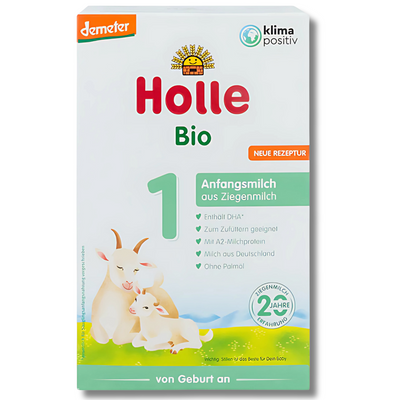
Holle goat milk formula is Holle’s goat-milk infant formula, made with full-cream (whole) goat’s milk. It is a complete infant formula for healthy babies in the age range on the pack, when formula is needed. It is not a medicine, and it is not a CMPA formula.
On Holle’s official Stage 1 product page, the recipe is suitable from birth when an infant is not breastfed, or not fully breastfed. Holle has sold goat-milk formula for more than 20 years and dates its first special goat-milk baby food to 2001.
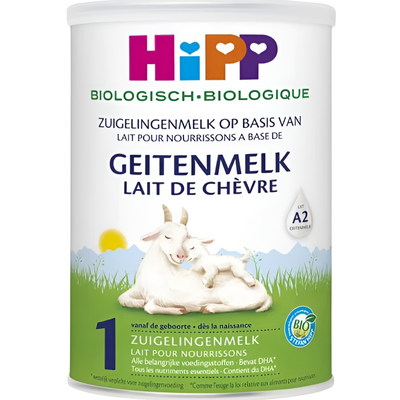
There is a German-packed range, usually in boxes, and a Dutch-packed range, usually in larger tins. Packaging, later-stage carbohydrates, and label language can differ. Compare them in Holle Dutch vs German Goat Formula, then choose the stage you need.
Who it may suit — and a clear limit
Holle goat milk formula may be considered, with a pediatrician’s agreement, for a healthy baby who needs infant formula and whose doctor has not diagnosed a cow’s milk protein allergy, or another milk-protein allergy. Some families compare it with a standard cow’s milk formula as a tolerance or preference question. That conversation belongs with the clinician who knows your baby.
It is not a home test for allergy. It is not lactose-free. It is not hypoallergenic. It is not a substitute for breast milk.
If CMPA has been diagnosed, or you strongly suspect it, do not switch to goat milk formula unless a doctor has given you different, specific instructions. Goat milk proteins are similar to cow’s milk proteins. They often cross-react, so many babies who react to cow’s milk protein also react to goat’s milk. For background on what clinicians usually mean by a CMPA formula, see Beyond the Moo: Loving Alternatives for Babies with CMPA and speak with your doctor before changing anything.
Ingredients and certifications
On Holle’s official Stage 1 product page, Stage 1 uses lactose as the carbohydrate. Holle states that this stage contains only lactose. The vegetable oils are sunflower and rapeseed. The official page states there is no palm oil. DHA comes from microalgae (Schizochytrium sp.), not fish oil, and ARA from Mortierella alpina is also included. Holle states on the ingredient panel that goat’s milk naturally contains the A2 protein.
Official Holle materials also describe short- and medium-chain fatty acids in goat milk. That is a compositional description, not a promise about colic, constipation, or allergy.
Later stages, and Dutch-packed tins, can differ in carbohydrates or other label details. Always read the pack in your hands rather than assuming every stage matches Stage 1.
Holle Goat is organic and also carries Demeter biodynamic certification. Holle presents Demeter as stricter than standard EU organic rules, including year-round access to fresh air for the animals, a high share of feed from the farm or the region, and a ban on dehorning. Holle says it is the only producer offering infant goat milk in Demeter quality, including after age one. The milk is associated with Demeter farms in Germany’s Sauerland and southern Black Forest.
The algae DHA may matter to families who want to avoid fish oil. Holle Goat is still a goat-milk formula, so it is not vegetarian or vegan. Plant-based infant formula is a specialist option to discuss with a doctor; see our guide to vegan baby formulas. The Soil Association mark is a UK organic certification used on some other brands. Holle Goat carries EU organic and Demeter marks, not that logo. Check the marks on the tin you receive.
Holle goat stages, including PRE and Stage 1
Official age guides are:
- Holle Goat PRE and Stage 1: from birth
- Stage 2: from the sixth month
- Stage 3: from the tenth month
- Stage 4: from one year
If you searched for “Holle PRE,” “Holle 1,” or “Holle goat milk formula Stage 1,” those names map to the early packs. Use the stage printed on your box or tin.
Holle goat milk formula stages
| Stage | Official age guide | Shop pages on hollehippos.eu |
|---|---|---|
| PRE | From birth | Holle Goat PRE |
| Stage 1 | From birth | Holle Goat Stage 1 (German pack); Holle Dutch Goat Stage 1 |
| Stage 2 | From the sixth month | Holle Goat Stage 2; Holle Dutch Goat Stage 2 |
| Stage 3 | From the tenth month | Holle Goat Stage 3; Holle Dutch Goat Stage 3 |
| Stage 4 | From one year | Holle Goat Stage 4; Holle Dutch Goat Stage 4 |
Stage 1 notes from the official page include lactose as the carbohydrate, no palm oil, and DHA from algae. Follow the wording on your own pack, especially for later stages and Dutch-packed tins.
A prepared bottle can look slightly different in colour from cow’s milk formula. That is often a feature of the milk, not automatic proof the tin has spoiled. Still follow storage rules. See Why goat milk formula changes color.
Taste and digestion
Parents often ask how Holle goat milk formula tastes, and whether it is digested in the same way as a cow’s-milk recipe. Taste is individual, and digestion is a question for your pediatrician, not a promise on a shop page.
The milk source is different from Holle’s cow’s-milk line. Goat milk is naturally high in A2-type beta-casein and forms a softer curd than typical cow’s milk. Official materials on short- and medium-chain fatty acids, already noted above, are compositional too. None of this is evidence that goat milk is “better,” easier for every baby, or equivalent to breast milk, and it is not a reason to use goat milk formula for CMPA.
Some families notice a different smell, taste, or stool colour after a switch. A colour change in the prepared bottle is explained in the colour guide linked above. None of these observations replaces medical advice if your baby seems unwell, is not feeding, or is not gaining weight.
EU and UK infant formulas, goat or cow, have to meet composition rules for complete nutrition in the stated age range. If feeding is unsettled, talk with your doctor before you change milk, and rule out allergy when that is a concern.
How to prepare Holle goat milk formula
Always follow the directions on the tin or box in your hands. Scoop sizes, water ratios, and cooling steps can differ by stage and by pack, including German boxes and Dutch tins. Do not mix a preparation table from a different country’s can, a different stage, or a different brand.
In general, the safe routine looks like this, unless your pack says otherwise:
- Wash your hands, and use clean, sterilised bottles and teats.
- Boil fresh drinking water, then let it cool to the temperature stated on your pack before you add powder.
- Use only the scoop that comes in that tin or box. Level each scoop as the instructions describe. Do not heap scoops or pack the powder down unless the pack says to.
- Add the water and powder in the order given on the label, close the bottle, and mix until the powder is dissolved.
- Cool the feed to feeding temperature if needed, and check a drop on the inside of your wrist before feeding.
- Discard leftover milk within the time on the pack. Store an opened tin as the pack directs.
If you are unsure about any line on a non-English label, compare it with the English information for the same stage, but the ratios on the pack in your hands still come first if they differ.
Holle goat milk formula vs Holle cow’s milk formula
When CMPA is not in the picture, the usual comparison is Holle’s goat line and Holle’s cow’s-milk line. Both are infant formulas for the age range on the pack, when formula is needed. Both should be chosen with professional advice. Neither is a treatment for diagnosed cow’s milk protein allergy.
Holle goat and Holle cow’s-milk formula, side by side
| Topic | Holle goat milk formula | Holle cow’s-milk formula |
|---|---|---|
| Milk source | Whole, or full-cream, goat’s milk | Cow’s milk; Holle also has a separate A2 cow’s-milk line |
| From-birth options | PRE and Stage 1 | PRE and Stage 1 |
| Certifications | EU organic and Demeter marks, according to Holle; not the Soil Association logo | Organic, with Demeter marks on some packs; check the tin you receive |
The usual differences people ask about are the milk source and how the milk forms a curd, as described above. That is not evidence that one line is superior, and it is not a reason to use goat milk for CMPA. Holle’s A2 cow’s-milk recipes are still cow’s-milk formulas.
If you want to compare packs, you can start with Holle Goat Stage 1 or Holle Dutch Goat Stage 1, and with Holle Cow Stage 1 or Holle Cow PRE. If allergy is still an open question, talk to your doctor first and do not use a goat product as a test.
A careful next step
If CMPA has been diagnosed, or you strongly suspect it, the next step is not a goat milk order. Speak with your pediatrician or GP, and use our CMPA alternatives guide to prepare questions.
If your doctor has said this is not a cow’s milk protein allergy, and you are comparing Holle goat milk formula with a standard cow’s milk formula, use the stage table above. For an early pack, start with Holle Goat PRE, Holle Goat Stage 1, or Holle Dutch Goat Stage 1. If you are choosing between German and Dutch packs, read Holle Dutch vs German Goat Formula first.
Frequently asked questions
Can I use Holle Goat from birth? Yes. PRE and Stage 1 are for use from birth when formula is needed. Confirm the wording on your box or tin. See Holle Goat PRE and Holle Goat Stage 1.
Does Holle Goat contain palm oil or fish oil? Official Stage 1 materials state no palm oil, and DHA from algae rather than fish oil. Check your pack, especially if you have a later stage or a Dutch-packed tin.
Is Holle Goat organic? Does it have the Soil Association mark? It is organic, and many packs also carry Demeter biodynamic certification. The Soil Association mark is a UK organic certification used on some other brands. Holle Goat carries EU organic and Demeter marks, not that logo. Look at the marks on the box you receive.
Is Holle Goat suitable for a cow’s milk allergy or CMPA? No, not for diagnosed CMPA, unless a doctor has given you different, specific instructions. It is not hypoallergenic. See our CMPA alternatives guide.
Is Holle Goat vegetarian or vegan? No. It is made from goat’s milk. Algae DHA only means the DHA is not from fish oil. For plant-based infant formula, talk with a doctor and see our guide to vegan baby formulas.
How do I prepare Holle goat milk formula? Follow the directions on the tin or box in your hands, using that pack’s scoop and water ratio. Do not copy a table from a different stage or a different country’s can.
How is Holle goat milk formula different from Holle cow’s milk formula? The milk source is different. Goat milk is naturally high in A2-type protein and forms a softer curd. That difference is not a reason to use goat milk for CMPA, and it is not a claim that one line is better than the other.
Why does prepared goat formula sometimes change colour? A colour difference can be a feature of the milk, not automatic proof the tin has spoiled. Follow storage rules, and read Why goat milk formula changes color.
Should I try Holle Goat while I wait for an allergy appointment? Do not use goat milk formula as a home test for CMPA. Ask the doctor who is seeing your baby what to feed until you have a plan.
Important notice: Breastfeeding is the recommended way to feed a baby whenever it is possible. This article is for general information. It does not replace personalised medical care. Please consult your pediatrician about feeding decisions for your baby.